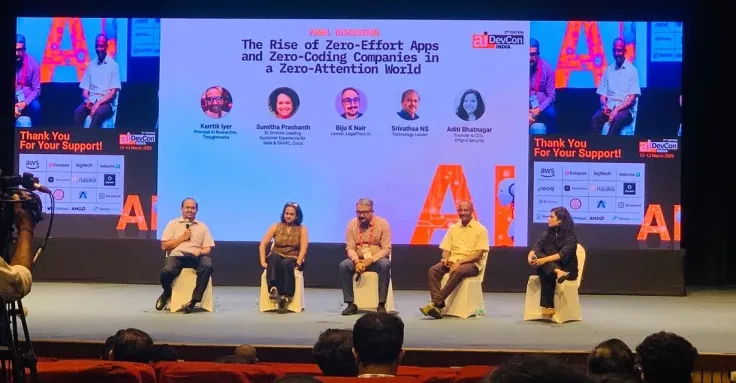
I recently attended a two-day conference that covered everything from AI-powered coding tools to data governance. Here’s what stuck with me — cleaned up from my raw notes, but keeping the takeaways.
Day 1
The Developer’s Job Is Changing. Fast.
Devin AI (by Cognition AI) and tools like Open Claw are pushing what AI assistants can do for developers. A new role is already emerging: Forward Deploy Engineers — people who work at the intersection of shipping AI products and solving customer problems on the ground.
But the more interesting conversation was about which skills are dying and which are becoming 10x more valuable.
Becoming obsolete:
- Writing boilerplate and CRUD from scratch
- Memorizing syntax and API signatures
- Being the “human Stack Overflow” for your team
- Treating typing speed as a competitive edge
- Migration, test-writing, and documentation grunt work
Becoming 10x more valuable:
- Specification and Scoping
- Architecture and System Design
- Code Review and Judgment
- Domain Understanding
- AI Orchestration
AI and the Law
The conversation around AI regulation is getting real. A few things came up:
- The India’s Digital Personal Data Protection Act and the importance of getting user consent right.
- India’s first major AI copyright lawsuit between OpenAI and ANI (Artificial Narrow Intelligence framing in legal contexts).
- The Clearview AI case as a cautionary tale on facial recognition and privacy violations.
- The role of a Data Protection Board in enforcement.
- GDPR continues to set the benchmark globally.
From Generation to Judgment
The most thought-provoking session reframed where AI is heading:
Generation → Agents → Judgment
The argument: we’ve solved generation. Agents are being figured out. The real unlock is AI systems that can scale judgment — not just produce output, but evaluate it.
The practical advice: focus on non-functional requirements, prioritize truth, and build governance into the system from day one.
Day 2
AI Is the New Keyboard
The framing here was sharp: the shift isn’t about AI replacing developers. It’s about the nature of the work changing.
- From syntax to systems
- From writing to reviewing
- From implementation to intent
What “thinking properly” now means for a developer:
- Understanding the requirement deeply before writing anything
- Exploring tradeoffs instead of jumping to the first solution
- Brainstorming architecture options
- Writing design ideas before writing code
AI is a force multiplier. Solo developers are now building startup-scale systems. But that only works if you bring the right skills:
- Structured thinking — breaking problems down clearly
- Critical evaluation — not blindly trusting AI output
- System and architecture thinking — seeing the whole, not just the parts
- Context ownership — you own the “why,” AI handles the “how”
A few honest reminders from this session:
- Engineers shouldn’t be scared of this technology. We should be the ones taking it forward.
- AI is currently most used in coding because it’s low-risk and measurable. It acts as an efficiency tool, not a replacement.
- Governance matters. Humans must stay in the loop.
- Trust and distribution — who owns the output? AI agents are not 100% correct. Humans remain credible, accountable, and responsible. AI agents can’t carry that weight yet.
Data Management in the AI Era
The data session reinforced something I’ve been thinking about in my own work:
- Data governance isn’t optional anymore. It’s the foundation.
- Trust is the critical layer. If your team doesn’t trust the data, nothing built on top of it matters.
- The shift from ETL to ELT is well underway — load first, transform later.
- The mindset shift: stop thinking about “datasets” and start thinking about data assets — things with clear ownership, quality standards, and documented lineage.
- Data Mesh is gaining traction as a decentralized approach to managing data across teams.
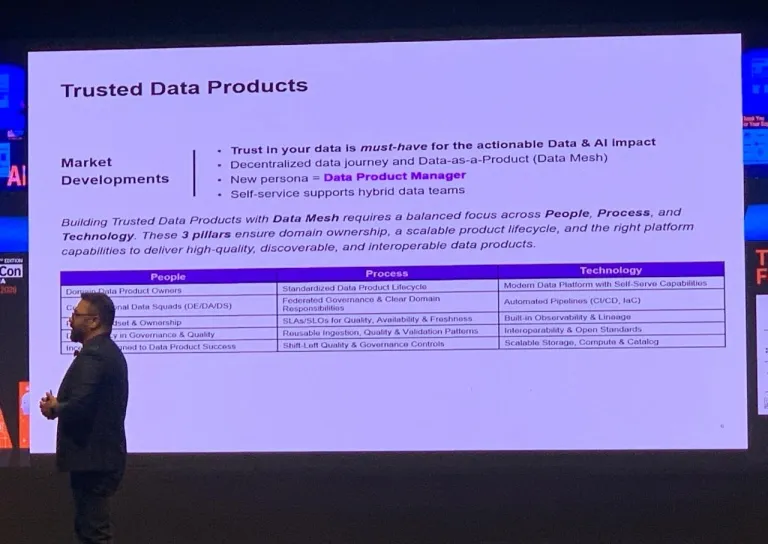
Key market developments discussed:
- Trust in your data is a must-have for actionable AI impact.
- Decentralized data journeys and Data-as-a-Product thinking are maturing.
- A new persona is emerging: the Data Product Manager.
My Takeaway
The thread running through both days was clear: AI doesn’t replace thinking. It raises the bar for it. The developers who thrive will be the ones who can specify clearly, design systems, exercise judgment, and stay accountable for the outcomes. The tools are getting better. The question is whether we are too.