📘 Summary
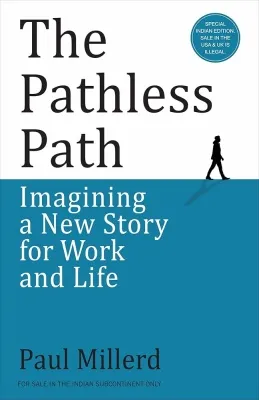
The Pathless Path is a reflection on redefining success, work, and life. It challenges the default narrative of success—go to school, get a job, climb the ladder, retire—and explores what happens when we step off that path.
Paul Millerd documents his journey from a successful corporate career into the unknown, fueled by a desire to live more intentionally and meaningfully. He introduces the idea of the “Pathless Path” as an alternative to the “default path.” It’s not a clear or easy road, but one guided by curiosity, values, and personal fulfillment.
Core Themes:
- Questioning conventional success and career ambitions.
- Valuing time, freedom, and creativity over status and money.
- Redefining work as something that fits into life, not life itself.
- Choosing personal growth and alignment over external validation.
- Living more deliberately, even without a clear plan.
Millerd draws from philosophy, spirituality, and modern reflections on work to invite readers to build a life from the inside out—one that aligns with who they truly are, not who they think they should be.
✍️ Formatted Highlights
Work was simply considered a necessary evil.
Aristotle, over 2,000 years ago, believed the aim of life was not work, but Eudaimonia means flourishing. Work was merely a means to an end, not the purpose of life.
The ultimate way you and I get lucky is if you have some success early in life, you get to find out early it doesn’t mean anything.” – David Foster Wallace
Early success can be a blessing in disguise—it reveals the emptiness of status-driven achievement.
Health, relationships, fun & creativity, and career.
A reminder that life is multi-dimensional. Career is only one piece of the puzzle; often, we neglect the others.
Some people inherit values and practices as a house they inhabit; some of us have to burn down that house, find our own ground, build from scratch…” – Rebecca Solnit
For many, growth means unlearning inherited scripts and rebuilding a life aligned with one’s own truth.
Work was literally not‐at‐leisure.
In classical times, work was defined by its contrast to leisure. Leisure was sacred—a time for contemplation, creativity, and being.
“We are not‐at‐leisure in order to be‐at‐leisure.” – Aristotle
Now reversed: we work endlessly, hoping for a little leisure. The ancient view was the opposite—work existed to support a flourishing life, not consume it.
“People mistake leisure for idleness, and work for creativity.” – Josef Pieper
Modern culture glorifies productivity. But true leisure, Pieper said, is a soulful state—deep reflection, joy, and connection.
“The more we associate experience with cash value… the more we convince ourselves we’re too poor to buy our freedom.” – Rolf Potts**
If everything is about money, then freedom feels unaffordable. But often, the real scarcity is imagination, not resources.
97% of people said their personal definition of success included being ‘the best they can be at what they care about most.’
Success is deeply personal. Most people want alignment—to live and work in service of what truly matters to them.
🧭 Concluding Thoughts
Stepping off the default path is not an escape—it’s a conscious return. A return to self, to soul, to the things we once knew but forgot: that life is not about checking boxes, impressing others, or accumulating accolades. It’s about flourishing, in the truest sense of the word.
We are not here just to work. We are here to live, to connect, to play, to wonder, to create. When we begin to see work as a part of life—not the whole of it—we make space for meaning to emerge.
The “pathless path” is not about having all the answers. It’s about being willing to ask the right questions:
- What do I truly value?
- What does freedom look like to me?
- What would I do if I wasn’t afraid?
Most people are quietly yearning for a life aligned with their deepest values. The pathless path is not easy, but it is alive. And that makes all the difference.
🌱 “Your life is your message. Make it one you’d want to read.”